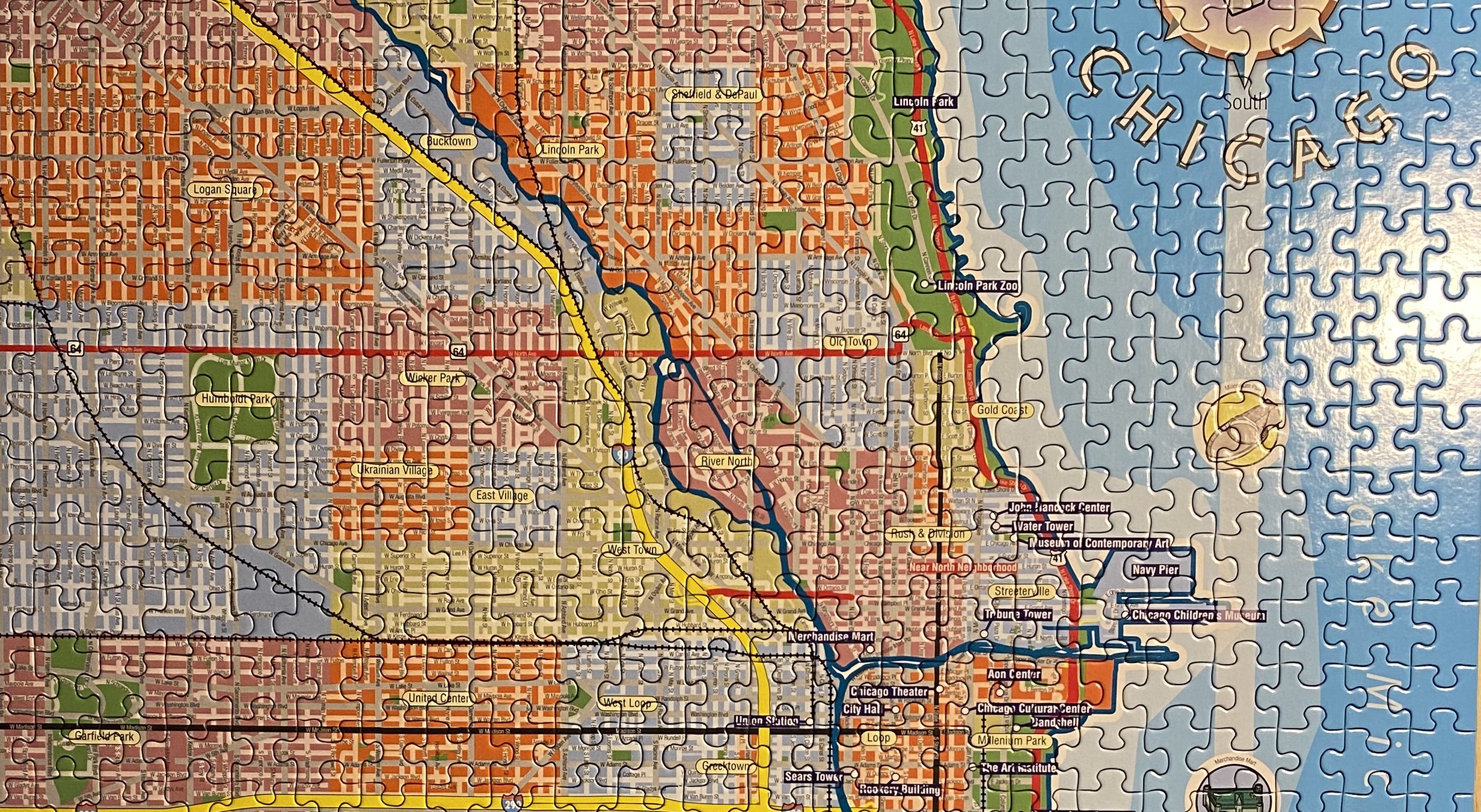
This week I finished a 1,000-piece Chicago map puzzle.
One of the reasons I picked this one was to get familiar with the streets, so I’d be less likely to get lost. These days, we rely so heavily on phones and technology to navigate the city. A traditional map feels like a break from that. And really, nothing feels more reassuring than being able to carry a mental map in your head.


Naturally, I started from the edge and tackled the lake first. Then I looked for clues like interstates, bold red roads, train tracks, and rivers, all of which sliced the map into sections. It felt a bit like how a spider spins its web.
I was able to build the structure quickly because of those clear visual anchors. I made about 50% progress in the first two days with relatively little effort.
Then it got hard.
Really hard.
Once I started working on areas without obvious visual clues, everything slowed down. The pieces all looked the same, monotone sections, uniform textures, repeating patterns, and the only thing you had to go on were random street names in tiny text that gave you eye strain. Trying to figure out where one piece belonged started to feel less like a relaxing activity and more like a test of patience.
Sometimes it took me five minutes to figure out a single piece.
At that point, it wasn’t that I couldn’t keep going, it was that my focus had shifted. I wasn’t enjoying it anymore; I just wanted to finish it. So I took a break for a day.
Sometimes, you have to pause to speed up.
During that pause, I reflected on a few things I’d noticed during the process:
I worked much faster in areas I was already familiar with. My existing knowledge of the map definitely helped. So the next day, I opened Google Maps and tried to memorize key areas, especially major roads. That turned out to be tremendously helpful. I was able to quickly locate where pieces belonged.
Turns out, the real learning happened outside the puzzle. (Thanks, Google Maps.)
People always say “learning by doing” is the best way to learn something. But I’d argue that sometimes you need to understand the theory first. “Just do it” might work eventually, but combining doing with a bit of theory? That’s the sweet spot.
Another thing I noticed:
I often jumped right into hunting for a piece once I had a general idea of what it looked like. But when I slowed down and spent a bit more time imagining the piece, its exact shape, the nuances of the “ins” and “outs”, I found it way more efficiently. Imagination helps. Sometimes, spending a little more time defining the goal is more effective than diving in when your goal is still fuzzy.
Also, the key to puzzles? Connection. That’s literally the whole point.
I also realized I wasted a lot of time searching for pieces that didn’t exist or didn’t look how I expected. Nothing makes you question reality like swearing a piece should fit, only to find out it doesn’t. Or believing a piece must look a certain way, then realizing it was a complete illusion.
Sometimes, our beliefs are just really confident mistakes.
In those moments, starting a new section or shifting perspective really helped. When your brain is stuck in a zone, jumping out of it and refreshing your perspective can make all the difference.
Once I made those adjustments, the process went much smoother. It only took me a few more hours to finish the rest.
Overall, it was a great experience. It’s essentially the only time people voluntarily suffer in silence for hours and call it “fun.” I’m not just solving a puzzle, I’m becoming a better person through slow torment and eye strain. Puzzles are basically life in miniature. They teach us about progress, certainty, flow, frustration and when to take breaks.